Is Private Credit Normalizing?
The consensus on private credit right now is calm, and it is calm for a defensible reason. First-quarter data show non-accruals ticking up only modestly, realized losses still running below their long-run average, and net unrealized markdowns that look proportionate to the volatility in syndicated markets. The honest version of the bull case is not "nothing is wrong" but "this is normalization, not deterioration, and credit holds up so long as the fund-financing markets stay open."
I want to take that last clause seriously. Every reassuring number in that paragraph describes the asset side of a business development company (BDC): what the loans are worth, how many are impaired, what has been written down. The conditional, so long as financing stays open, describes the liability side. And the structure of the liability side makes private credit potentially fragile. In a hand-collected, facility-level panel of 195 U.S. BDCs from 2017 to 2025 (roughly $267 billion outstanding as of 2025) that Elisavet Mistopoulou and I assemble from SEC filings, three facts sit uncomfortably alongside the “sanguine” view.
"As long as financing stays open" hides two rollover decisions, not one
The financing that has to stay open comes in two forms, and private BDCs are increasingly exposed to both.
The bank-renewal decision.The median private BDC has no unsecured bond access at all and funds through bank revolvers and securitized warehouse lines. Banks discipline these funds through *maturity* rather than price: private-BDC revolvers carry a median remaining maturity of 2.0 years versus 3.8 for listed BDCs, at statistically identical spreads. The result is that 11.4% of private-BDC revolver funding matures within twelve months, against 1.4% for public BDCs; near-term rollover risk concentrated in the most opaque segment of the market. The spigot is narrow: roughly fifteen lead arrangers control the bulk of BDC credit capacity, with the top five arranging 87% of revolver commitments. For most of the market, whether a private BDC can roll is a renewal decision made by one or two banks.
The market-refinancing decision. Here is what the bank-dependence framing misses, and it is the part changing fastest. The largest private BDCs have grown out of pure bank dependence and into the unsecured bond market and in doing so have taken on a second kind of rollover risk: a market-revolving decision, made not by a relationship bank but by anonymous bond investors who can simply decline to show up. The aggregate unsecured-note rollover wall has already gone from $2.4 billion maturing in 2023 to $18.1 billion in 2026, arriving with front-end rates still well above the coupons struck on the 2020–21 vintage.
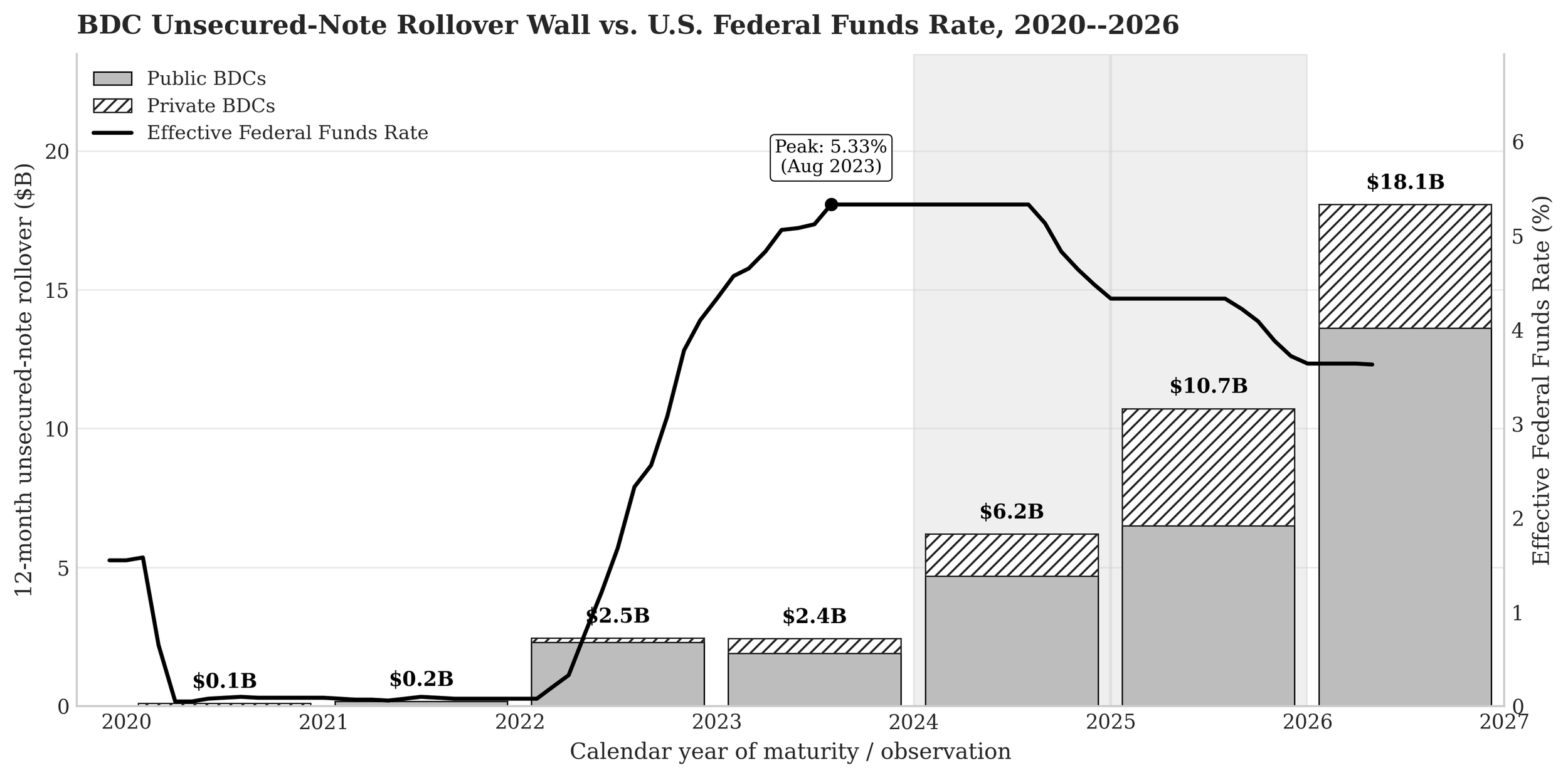
Figure 1. Chart of the BDC unsecured-note 12-month rollover wall against the US federal funds rate, rising from $2.4B in 2023 to $18.1B in 2026.
And this is no longer a public-BDC story. Splitting the forward unsecured maturity wall by listing status shows the private-BDC bond stack building from $3.8 billion maturing in 2026 to $8.5 billion in 2029 and $9.4 billion in 2030, the year private-BDC unsecured maturities actually overtake those of listed BDCs. The non-traded funds that tapped the bond market in the more recent years have manufactured a refinancing wall concentrated in 2028–2030, that must be cleared through public capital markets which are open to them only on good days. Crucially, the two channels are correlated rather than diversifying: if the unsecured market is shut to non-traded issuers precisely when that wall hits, the fallback is the same short-dated, concentrated bank lines described above. Rollover risk for a private BDC is no longer just "will my bank renew?" It is now also "will the bond market be open at the refinancing date?" And, increasingly both questions come due in the same window.
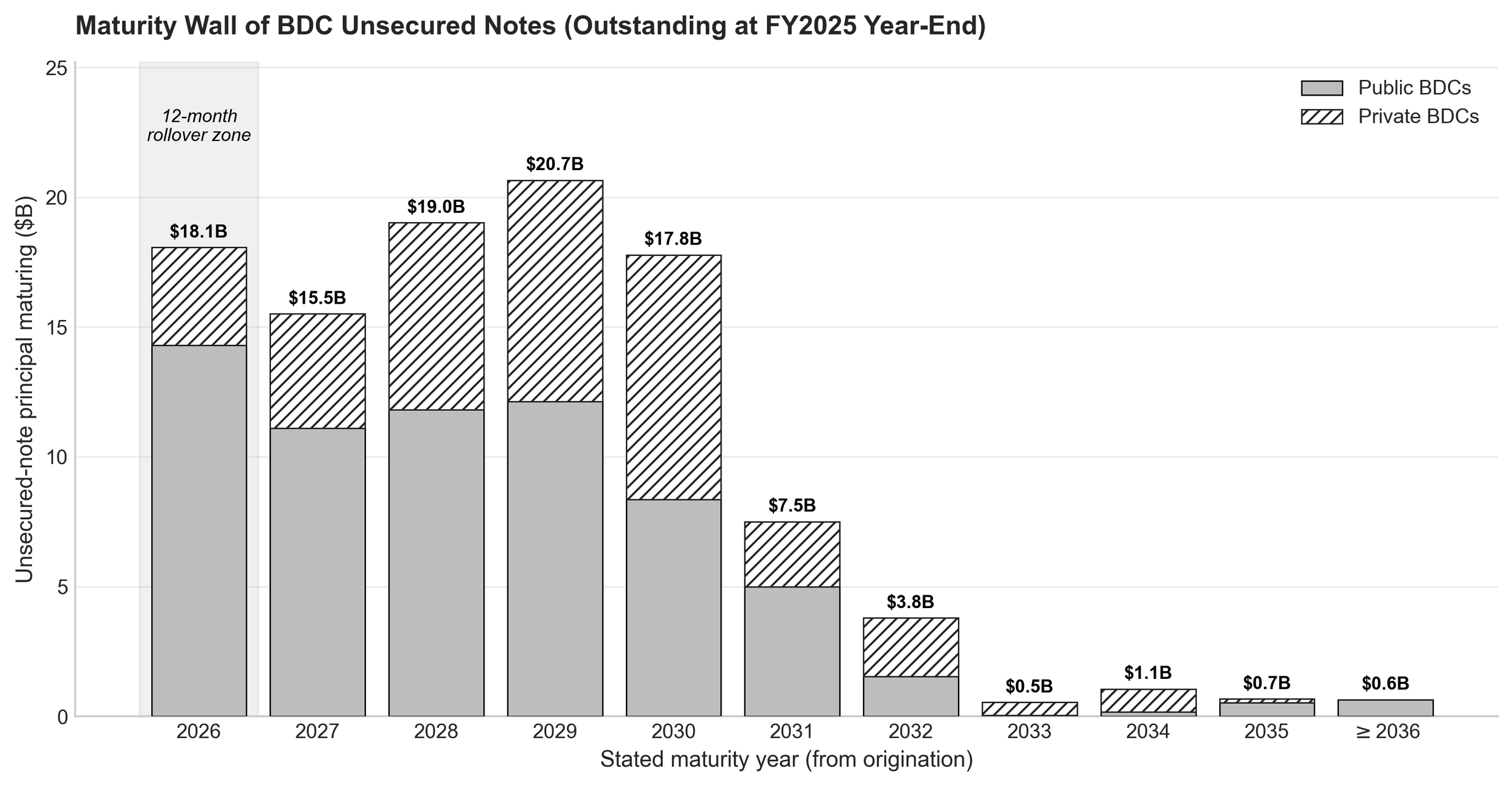
Figure 2. Forward unsecured-note maturity wall of private vs public BDCs; the private-BDC bond wall builds to $8.5B in 2029 and $9.4B in 2030.
Redemptions are not a "known known"
The comfortable framing treats retail redemptions as priced-in noise: a known share of AUM, a known quarterly window, institutional capital that does not run. But the data on actual tender activity do not look like a settled problem. Quarterly redemption requests at semi-liquid BDCs have climbed to record levels, the number of funds running redemption programs has more than tripled over the past five years, and a persistent 70% of them impose gates or prorate fulfillment in any given quarter. A "known known" that is increasingly met by not paying redeemers in full is not benign. It is a queue forming behind a gate, and the next window is open now for the second quarter of 2026.
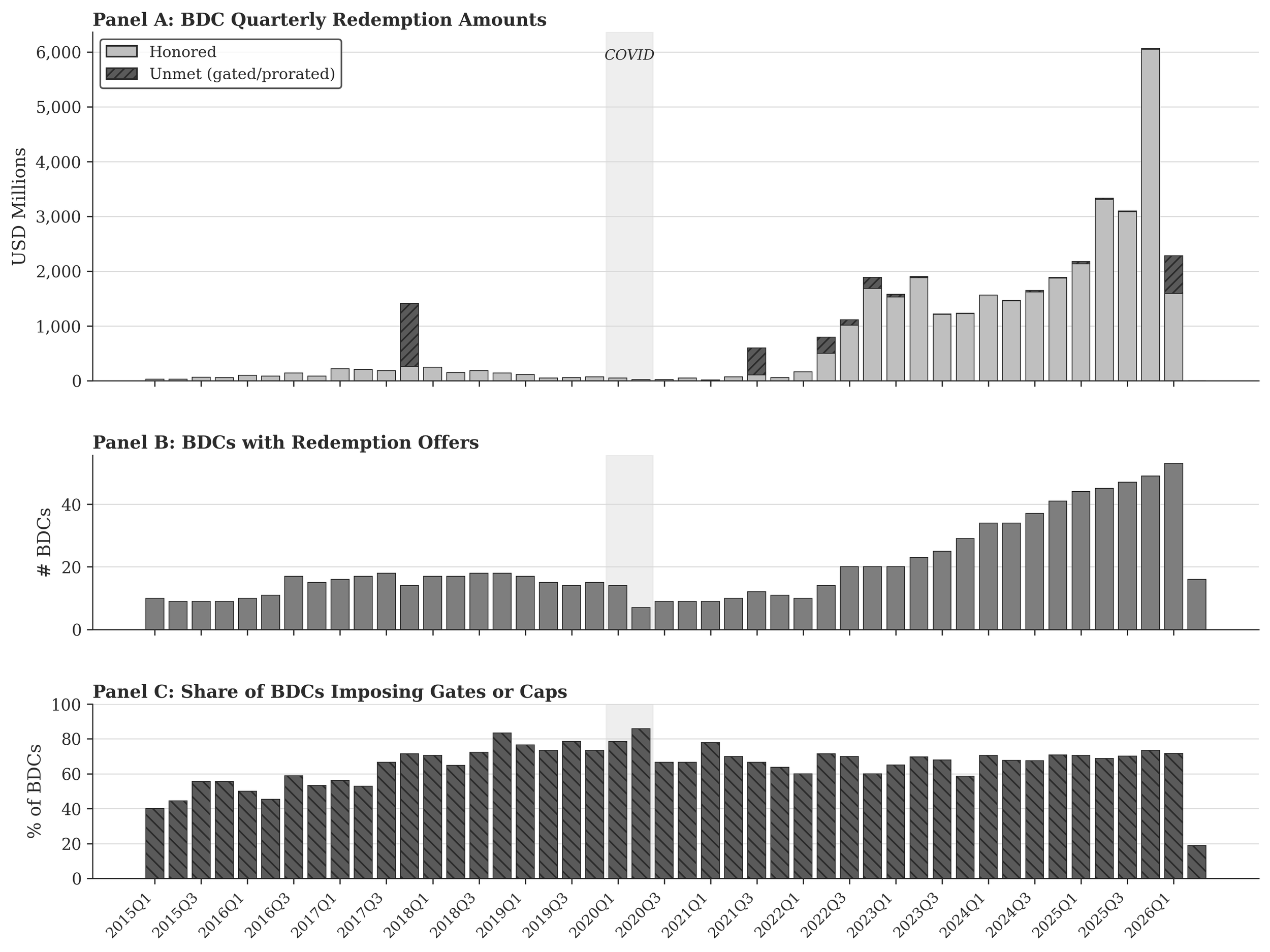
Figure 3. Time series of BDC quarterly redemptions, count of funds offering redemptions, and share imposing gates or caps, 2015–2026.
How the largest funds met those redemptions is the real tell
Here is the fact the loss statistics cannot show you. Faced with outflows in 2025–26, the largest private BDCs did not have to sell assets into a soft secondary market and materialize losses, which is exactly why realized losses look contained. Instead they layered on secured leverage. Across the ten largest private BDCs, the funding stack grew 46% in a single year, SPV warehouse utilization climbed from 63% to 76%, and aggregate leverage rose. The corporate revolver, the designated emergency backstop, was deliberately de-utilized while term and securitized funding was pushed up through other channels.
This resolves the immediate liquidity mismatch and keeps reported losses low. It does so by encumbering more of the portfolio, subordinating the investors who do not redeem, and deepening the interconnection with bank and CLO counterparties. None of that is visible in a non-accrual rate or a leverage ratio. It is the clearest example I know of why "fundamentals are normalizing" and "the funding structure is getting more fragile" can both be true at once.
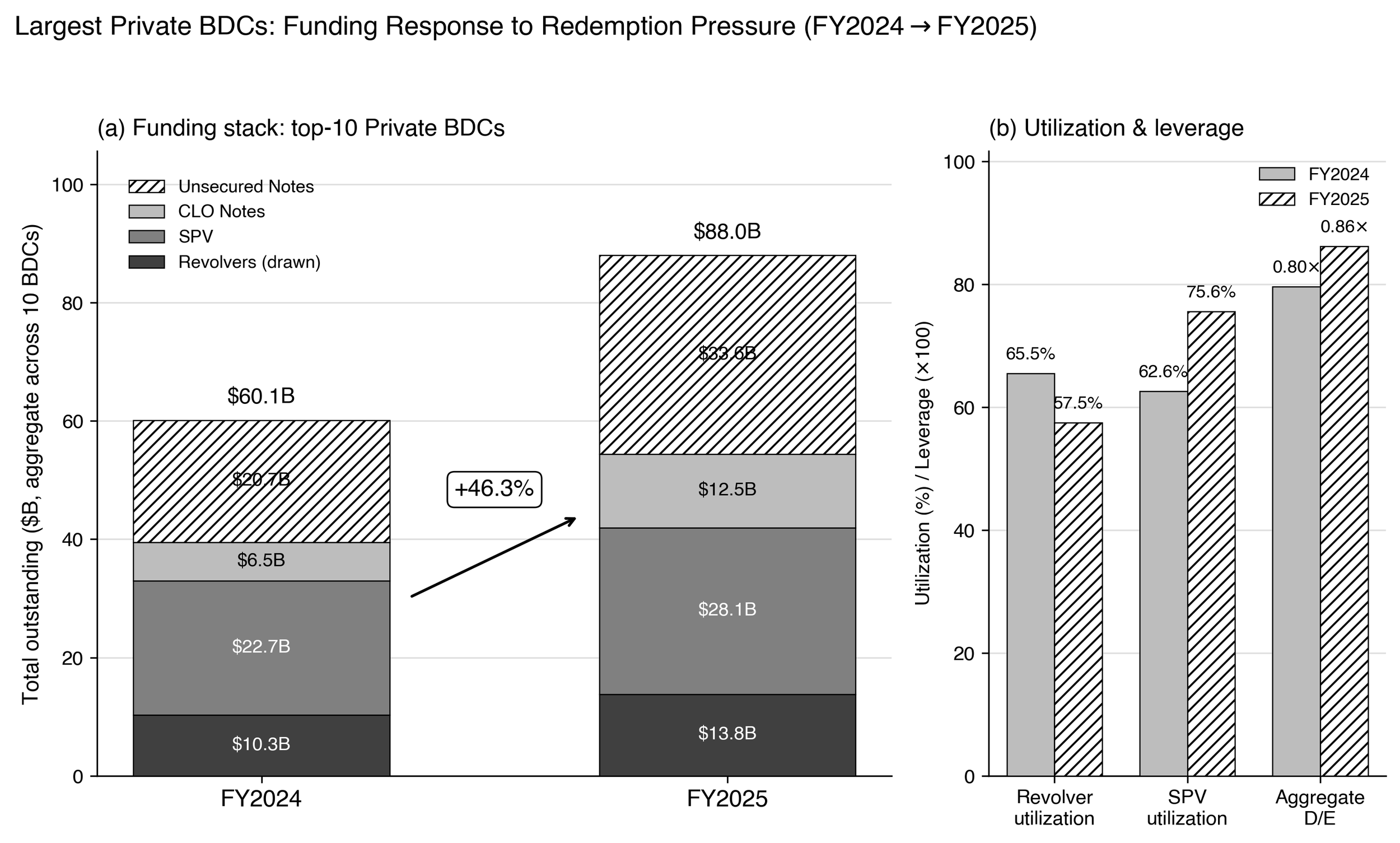
Figure 4. Funding response of the ten largest private BDCs to redemption pressure: funding stack up 46% and SPV utilization rising from 63% to 76%.
When asset risk becomes funding risk
The three fragilities above are usually discussed as if the asset side were a separate and currently calm question. Banks, however, lend to BDCs short because short-term debt is how a lender disciplines a borrower it cannot fully observe: the riskier the book, the more frequent the renewal decision. The data show this directly: BDCs with a high share of non-accrual loans receive the shortest revolvers. The implication is that a BDC's rollover terms are function of its portfolio risk. As credit quality deteriorates, the maturity at which banks will refinance shortens, borrowing bases tighten, and a renewal that looked automatic becomes uncertain.
What makes this cycle harder to read is that some of that risk has been masked before it can show up in the metrics that would normally trigger discipline. The most visible channel is payment-in-kind (PIK): a borrower defers cash interest into principal, the loan stays current on paper and out of the non-accrual count, and the lender receives no cash. In work with Paul Rintamäki, we show that PIK toggled on after origination is forbearance rather than flexibility; it roughly doubles the 3% probability a loan lands in non-accrual over the next two years and comes with a markdown to fair value. It is extend-and-pretend, across sectors and industries, with no capital charge on the lender to stop it. Forbearance does not remove the risk; it delays the moment of recognition and pushes that moment closer to the refinancing wall.
Layered on top is concentration. A meaningful slice of the loans now approaching maturity was originated in the 2021 vintage and in software and AI-exposed borrowers, firms that took on debt in the cheap-money window and may struggle to service it today. Some are already zombies, kept current through PIK; many are not, and simply face a refinancing they cannot easily meet. Either way the weak names are correlated and might come due together. When they do, banks tighten precisely the funds most exposed to them, the unsecured market reprices precisely those issuers, and a BDC short of cash must refinance into the renewal decisions shown above to be fragile or sell the assets it had been carrying near par at uncertain valuations.
The point for regulators
The academic and supervisory debate has largely asked whether BDCs can absorb losses, and the answer is reassuring: equity cushions are large, statutory leverage is capped near 2.0x, and stress tests rarely produce fund-level defaults. That is the wrong question for this part of the cycle. Solvency is not the binding constraint. A perfectly solvent BDC still faces rollover risk if its single revolver matures and the bank declines to renew; borrowing-base risk if collateral deterioration forces SPV deleveraging; and contagion risk if its lead arranger tightens terms across eight relationships at once. These mechanisms require no insolvency and no covenant breach, and they are invisible in exactly the metrics the consensus is leaning on.
The FSB's May 2026 report named bank–private-credit interlinkages and valuation opacity as the two priority vulnerabilities, while conceding that data gaps frustrate monitoring. The facility-level evidence closes part of that gap, and it points the same way: the risk in private credit today is not that the loans are secretly worthless. It is that the most opaque, fastest-growing funds finance themselves short, from a handful of banks, behind redemption gates, and are responding to the first real test by adding leverage rather than taking losses. That is a funding-structure problem, and it will not show up in a non-accrual rate until it is already a liquidity event.
The data and figures in this post are drawn from Elisavet Mistopoulou and Sascha Steffen, "The Funding Structure of Direct Lenders" (working paper, Frankfurt School of Finance & Management, 2026).
Author: Sascha Steffen is the DWS Senior Chair in Finance and Professor of Finance at the Frankfurt School of Finance & Management. He is academic director of the Centre for European Transformation.