Europe's private credit fundraising just hit a record — and ELTIF 2.0 has opened a second fundraising dimension
The narrative on European private credit has flipped. For years the region was the "smaller sibling" of the US market due to, for example, deeper bank penetration, fewer sponsor deals, less LP appetite. This has changed in 2025-2026 (see Figure 1).
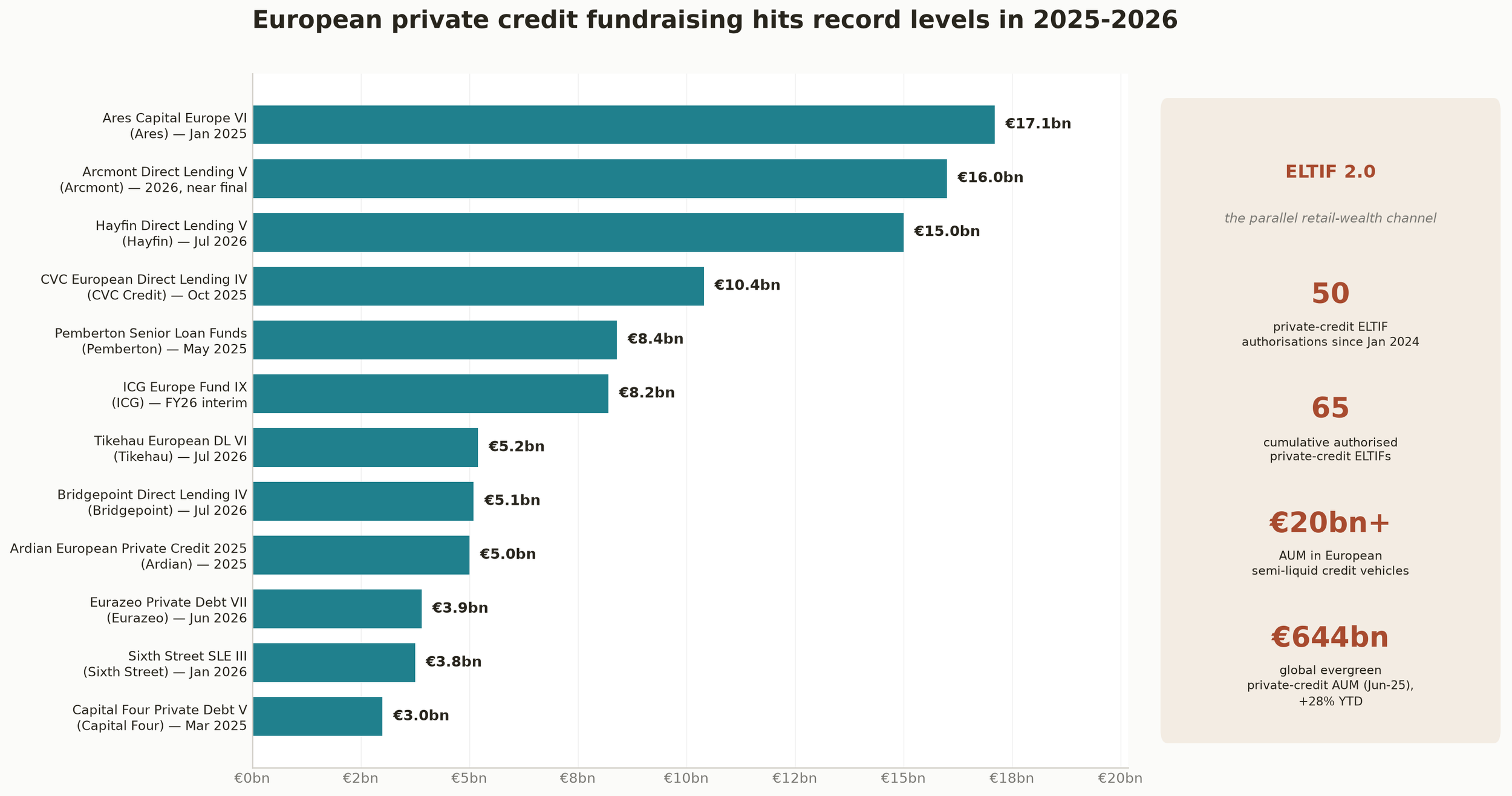
Figure 1: 12 largest closed-end funds; evergreen ELTIF/LTAF vehicles summarised in side panel. Source: Own data collection.
A record year
European-focused private credit funds raised roughly $65 billion in the first nine months of 2025 alone, already 14% above the full-year 2024 total of about $57bn. Europe's share of global private debt fundraising climbed from about 24% in 2023–2024 to 35% in Q1-Q3 2025.
The growth is dominated by an unusually number of mega-funds:
Hayfin Direct Lending V — €15bn+, roughly 2.5× the prior vintage.
Arcmont Direct Lending V — reported at €15–17bn in market, nearing final close.
CVC European Direct Lending IV — €10.4bn, versus €6.3bn in 2022 and just €1.3bn in 2020.
ICG Europe IX — €8.2bn interim, on track to be ICG's largest commingled fund ever.
Pemberton, Tikehau, Bridgepoint, Eurazeo, Ardian, Sixth Street — each closed their largest-ever European direct-lending vehicle in the window.
Ares Capital Europe VI — €17.1bn LP equity (€30bn including leverage), one of the largest European direct-lending funds ever closed.
This is a structural change: six European direct-lending funds have now cleared the €10bn hurdle within a single 18-month window. This has not happened before.
The demand for European private credit is not European demand
Tikehau reports about 29% of its DL VI capital from Asian and Middle Eastern LPs. Eurazeo VII took >60% of commitments from North America and Asia. Pemberton flagged 70 new clients from Asia, Middle East and North America. Apera raised across Northern Europe, Asia and North America. Pan-regional insurers, sovereigns and pensions are treating European direct lending as a strategic diversifier away from a US market they consider crowded and spread-compressed.
That is materially different from the 2018–2022 European fundraising cycle, which leaned heavily on European institutional balance sheets.
ELTIF 2.0 as the second, parallel fundraising dimension
In addition to institutional investors, there is a new and completely different fundraising channel that barely existed 24 months ago: evergreen, semi-liquid vehicles distributed to wealth and (to a lesser extent) retail investors.
The trigger was regulatory. ELTIF 2.0 (Regulation (EU) 2023/606, applicable from 10 January 2024) rewrote the rulebook of the original 2015 European Long-Term Investment Fund regime:
The €10,000 retail minimum ticket disappeared.
The 10%-of-net-worth allocation cap for investors below €500k was removed, replaced by a MiFID II suitability test.
The eligible-asset universe was widened: fund-of-funds and master-feeder structures were permitted, listed companies up to €1.5bn market cap became eligible, and leverage limits for retail-marketed ELTIFs rose to 50% of NAV.
The liquidity toolkit was formalised: matching mechanisms, redemption gates, and semi-liquid share classes are now explicitly allowed inside the so-called “liquidity wrapper.”
In the 62 vehicles, I tracked over Jan-2025 to Jul-2026, roughly a third are ELTIF 2.0, LTAF or otherwise semi-liquid. The launch list includes AXA IM Alts, Apollo, Ares, Goldman Sachs, Invesco, Morgan Stanley IM, Muzinich, Tikehau, Eiffel, SEB/Capital Four, DWS/Partners Group, Anthilia, plus UK LTAFs from Aegon, M&G, Partners Group and Apollo/Carne.
The AUM numbers are still small compared to the institutional fundraising, but the growth is not small: European semi-liquid private-credit vehicles now hold over €20bn in AUM, and Blackstone's ECRED alone reported €2.6bn NAV at 2Q25 after roughly tripling in the year to January. Globally, evergreen private-credit AUM reached $644bn at 30 June 2025, up about 45% year-over-year.
Managers responded fast. According to With Intelligence's analysis of ESMA data, there have been 50 authorisations of ELTIFs focused at least partly on private credit since January 2024, taking the cumulative total to 65. Luxembourg's ELTIF count rose from 23 in 2021 to 148 by end-2025 according to EY.
ELTIF 2.0 is not driving the fundraising record in 2025-2026, though
The mega closed-end fund structures listed above were mostly raised from the same institutional universe that has funded European direct lending for a decade. ELTIF 2.0 did not anchor Ares VI, Hayfin V, Arcmont V or CVC IV.
What ELTIF 2.0 is doing is different, and arguably more interesting from a market-structure perspective:
It has industrialised a wealth-distribution rail. GPs that previously had no economic path to European private-banks and life-insurers now have a standardised, passportable vehicle. The marginal LP is a private-bank client.
It is compounding the fundraising cycle. Evergreen NAV growth does not show up in league tables of "final closes" but shows up mechanically in AUM every quarter. ECRED's tripling is a preview.
It is beginning to change fund architecture. Look at Tikehau launching TEPC as a 99-year Luxembourg Part II semi-liquid vehicle alongside its closed-end institutional DL VI; Eurazeo pairing EPD VII with €1bn of pan-European evergreen wealth vehicles; SEB partnering with Capital Four on a perpetual ELTIF; Apollo authorising three sister ELTIFs on a single day for EMEA, Asia and LatAm wealth. The dominant fundraising model in Europe is now a dual-track process feeding both institutional and wealth capital into the same fund structure.
So the fundraising record is still an institutional story, powered by non-European LPs looking for spread and geographic diversification away from a US market.
What this means for European private credit
A few implications worth watching from an academic and policy angle:
Concentration will keep rising. A €500bn-and-growing market where six managers control the mega-vintages, and where the same names dominate the ELTIF wealth pipeline, is not a diversified non-bank ecosystem. Systemic-risk analysis needs to move past "private credit = shadow banking in general" to specifically map the top 10 European GPs, their leverage, their funding maturities and their liquidity terms.
Liability structure is the new frontier of risk. Closed-end drawdown funds have no run risk. Semi-liquid ELTIFs, LTAFs and evergreen vehicles absolutely do as recent US non-traded BDC gating episodes underline. The BDC-style funding fragility literature becomes directly relevant to Europe as ELTIF NAV growth (see my paper with Elisavet Mistopoulou - “The Funding Structure of Direct Lenders”)
Retail investor protection is only partly solved. ELTIF 2.0 replaced blunt caps with MiFID II suitability. That is a regulatory bet on distribution quality, not on product safety. If a large evergreen ELTIF has to gate during a European downturn, the political economy of the regime will be tested for the first time.
The bank–non-bank nexus in Europe will shift. As direct-lending capacity scales from about €340bn AUM today toward about €500bn, the classic Schuldschein / mid-cap Bank-Loan / direct-lending competition will move from anecdote to measurable substitution (see Ardian).
Bottom line
Europe is running two fundraising channels in parallel: an institutional (mega-fund) channel producing €10bn+ closed-end funds and an ELTIF/LTAF-powered wealth channel that is small today but growing fast.
That is, record institutional inflows plus a newly opened retail-wealth channel is the combination supporting the "European private credit is scaling" thesis in 2026.
The interesting policy work now begins.
Data sources: a dataset of 62 European private-credit fundraising events between January 2025 and July 2026 (final and interim closes, hard-cap closes, ELTIF/LTAF launches and authorisations); Private Debt Investor, With Intelligence, ESMA’ ELTIF register, manager disclosures. Feedback and additions welcome (private credit data quality is still the binding constraint).
#PrivateCredit #DirectLending #ELTIF #EuropeanFinance #PrivateDebt #Fundraising #FinancialIntermediation