Who bears the risk in Nvidia's $500 billion financing platform?
Who ultimately bears the credit risk when a chipmaker organizes half a trillion dollars of debt for its own customers? That is the question raised by Nvidia's announcement of August 10, 2026: memoranda of understanding with Apollo, BlackRock, Blackstone, Brookfield, Goldman Sachs and KKR to mobilize more than $500 billion of third-party capital into "independent compute financing platforms" that will lend to Nvidia's customers. The answer this post develops is that the risk travels a long way: not to Nvidia, not to the banks, but through special purpose vehicles into insurance balance sheets, where it arrives relabeled as investment-grade fixed income.
Three facts frame the announcement. First, nothing has been committed. The agreements are non-binding MOUs, subject to definitive documentation, and no per-partner allocation has been disclosed. Second, Nvidia is not lending its own money. The capital sits with the six managers; Nvidia’s stated role is that of a facilitator, though Jensen Huang has said the company retains the option to backstop up to $125 billion, or a quarter of the potential deals. Third, the announcement formalizes a shift that is already well advanced. Incremental debt funded about 9% of hyperscaler capital expenditure in fiscal 2024 and roughly 32% on a trailing basis by mid-2026, and US data-center debt issuance roughly doubled to about $182 billion in 2025. The platforms are the institutionalization of this shift.
The structure
Figure 1 shows the flows. Capital enters at the top from insurance general accounts and long-duration mandates: Apollo owns the annuity writer Athene, KKR owns Global Atlantic, Brookfield has its Wealth Solutions arm, and PIMCO and BlackRock run large insurance mandates. The platforms lend to the operating layer, mostly so-called neoclouds such as CoreWeave, Crusoe and Nebius, and to project vehicles that build data centers. The borrowers spend the proceeds largely on Nvidia hardware. They are repaid from offtake contracts, and here the chain splits into the two branches on which the entire credit assessment turns: contracts with hyperscalers, and contracts with AI labs.
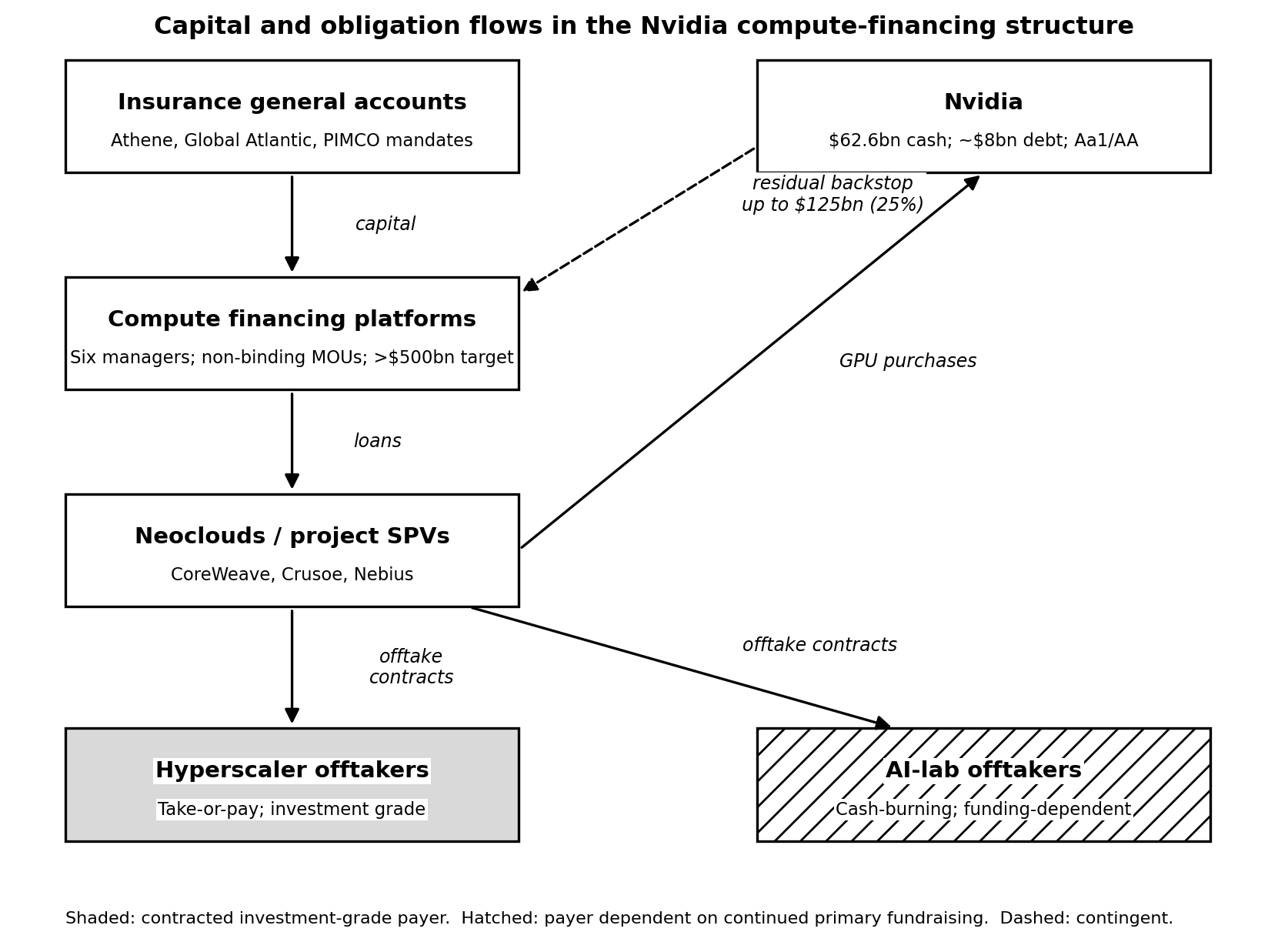
Figure 1. Capital flow diagram of Nvidia's $500bn compute financing platforms, from insurance general accounts through SPVs to hyperscaler and AI-lab offtakers
The template for what the platforms will produce already exists. CoreWeave's fourth delayed-draw term loan, closed in March 2026, is an $8.5 billion facility placed in a bankruptcy-remote SPV, secured by GPUs and customer contracts, rated A3 by Moody's, priced at SOFR plus 225 basis points with a fixed-rate equivalent near 5.9%, and anchored by Blackstone's credit and insurance business. Meta's Hyperion data center in Louisiana shows the same logic at larger scale: $27 billion of SPV debt rated A+, yielding 6.58% at issue, maturing 2049, with PIMCO reported to have taken roughly $18 billion. Meta holds 20% of the joint venture and keeps the debt off its balance sheet.
Table 1 summarizes the two reference transactions.
| CoreWeave DDTL 4.0 | Meta Hyperion | |
|---|---|---|
| Size | $8.5bn | $27bn debt, ~$2.5bn equity |
| Structure | Non-recourse SPV, GPU + contract collateral | SPV/JV, Blue Owl 80%, Meta 20% |
| Rating | A3 / A(low) / A-sf | A+ (S&P) |
| Pricing | SOFR + 225bp; ~5.9% fixed | 6.58% at issue |
| Maturity | 2032 | 2049, fully amortizing |
| Anchor investors | Blackstone Credit & Insurance | PIMCO ~$18bn; BlackRock >$3bn |
| Sponsor treatment | Off CoreWeave's corporate credit | Off Meta's balance sheet |
Table 1. The two reference transactions for the platform model. Sources at end.
Double-click to edit...
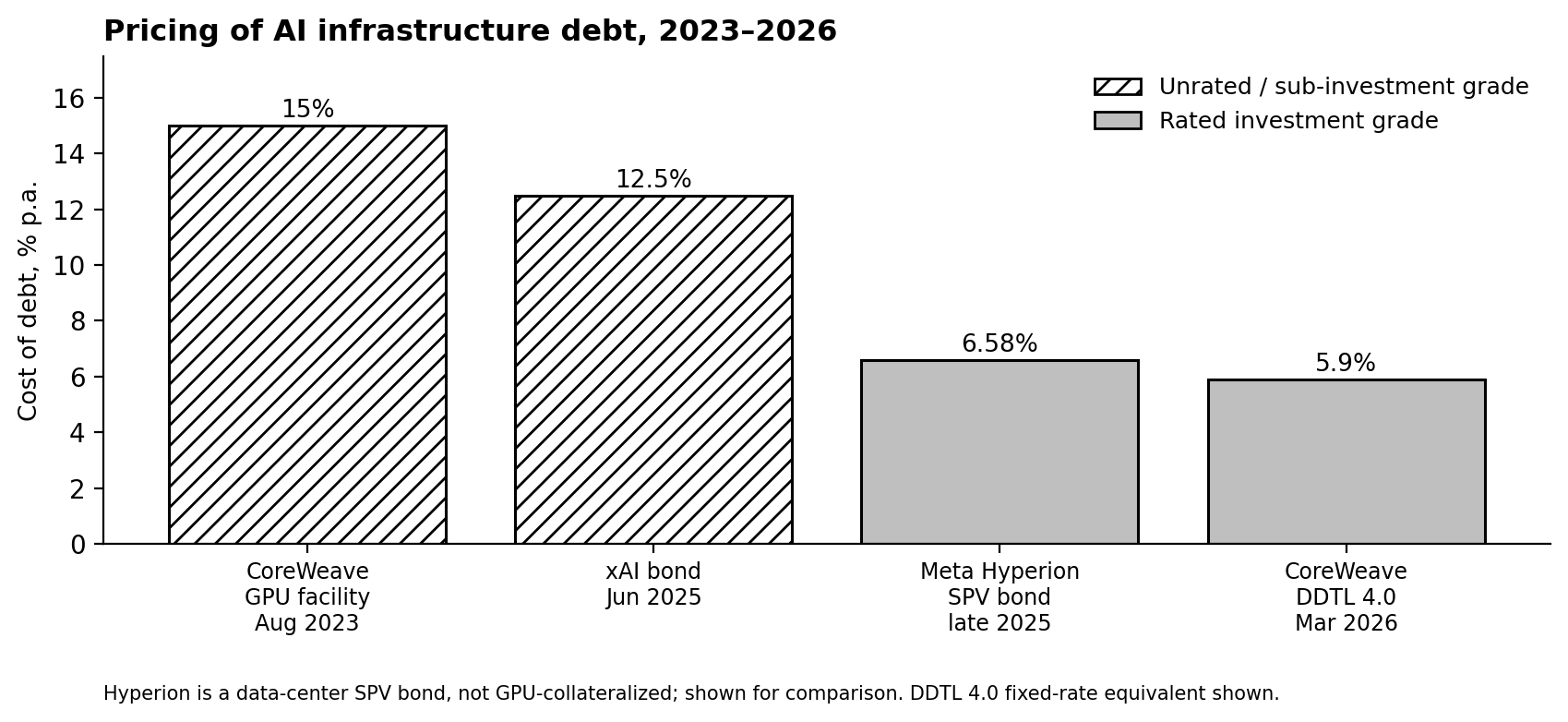
Figure 2. Cost of AI infrastructure debt 2023–2026, from 15% GPU-backed loans to 5.9% investment-grade facilities
The collateral question
A GPU is a poor collateral asset for long-dated debt. Nvidia ships a new architecture roughly every year, and the competitive life of a given generation is plausibly two to three years, while hyperscalers depreciate the hardware over five to six. Estimates of resale values diverge widely: industry data providers report H100s retaining roughly 50–70% of value at three years, while critics cite declines above 70% over the same horizon. Michael Burry has built a public short thesis on the gap, estimating that hyperscalers will understate depreciation by $176 billion between 2026 and 2028. Fitch, for its part, has an open consultation on how to treat residual values in these structures. The honest summary is that nobody knows, because the secondary market is young and the debt matures in 2032, 2049, or beyond.
The structures answer this problem. What makes the CoreWeave facility investment grade is not the chips; it is a take-or-pay contract under which an investment-grade hyperscaler owes the payments whether or not it uses the capacity, held in an SPV outside the borrower's estate. The rating agencies rate the payment stream, and the payment stream is only as good as the payer. Front-loaded amortization does the rest: if principal is repaid within the contracted period, residual value never has to be tested.
Hence the significance of the split at the bottom of Figure 1. Where the offtaker is Microsoft or Meta, the substitution works; the paper is a claim on some of the strongest balance sheets in the world, and the roughly 200 basis points over Treasuries is reasonable compensation. Where the ultimate payer is an AI lab, the substitution fails quietly. OpenAI generates annual recurring revenue of roughly $25 billion against a projected 2026 cash burn near $27 billion and cloud commitments to Microsoft, Oracle and Amazon that have been itemized at close to $590 billion. A take-or-pay contract from a counterparty that must keep raising primary capital to honor it is not credit substitution; it is credit deferral. Oracle sits between the two branches and illustrates the danger: about half of its $638 billion order backlog is attributed to OpenAI, its fiscal 2026 free cash flow was minus $23.7 billion, and S&P downgraded it to BBB-, one notch above high yield, in July 2026.
Who bears the risk
Follow the paper to its resting place and the answer is: insurance policyholders, several layers removed from the underwriting decision.
The banks arranging these deals hold little of them. Morgan Stanley ran the Hyperion placement as sole bookrunner and distributed it; PIMCO reportedly stepped into $10 billion of an Oracle-linked project bond after US banks pulled back. This is originate-to-distribute, and the destination is the general account of a life or annuity insurer. The logic is sound as far as it goes: annuity liabilities are long, fixed and hard to withdraw, and a 6.5% amortizing A-rated asset against a 3–4% crediting rate is exactly what such a balance sheet wants. The capital is genuinely not runnable in the way bank funding was in 2008.
Two qualifications matter. The first is affiliation. Three of the six platform managers own or control the insurers likely to hold the paper. The entity underwriting the credit and the entity bearing it share an owner, which weakens the discipline that arm's-length distribution is supposed to provide. Nvidia's announcement is routinely described as resolving the "circularity" of the company financing its own customers, and at the level of Nvidia's balance sheet it does. One layer down, a second circularity has been created.
The second is the downgrade channel. Non-runnable is not the same as loss-absorbing. Insurance capital charges under both the US risk-based capital regime and Solvency II are keyed to ratings. A downgrade of these structures, whether from an offtaker's deterioration or from a rating-agency methodology change on residual values, raises capital charges mechanically and can turn rating-constrained holders into forced sellers of an asset with almost no secondary market. The stress scenario for this asset class is credit risk migration.
Nvidia itself retains a defined tail. Figure 3 sets the company's resources against its contingent exposures: $62.6 billion of cash and securities and about $97 billion of fiscal 2026 free cash flow, against a residual backstop ceiling of $125 billion, purchase obligations of $95.2 billion (up from $16.1 billion a year earlier), an estimated $70 billion of ecosystem equity stakes, and a $6.3 billion CoreWeave capacity backstop. The bars should not be summed up; the backstop is a ceiling under agreements not yet executed, and only about $3.5 billion of lease guarantees is currently contracted. The analytically relevant feature is not the gross size but the correlation: the purchase obligations, the equity stakes and the residual support all crystallize in the same state of the world, an AI demand shortfall. Nvidia can absorb any one of these exposures comfortably. The joint draw is a different calculation.
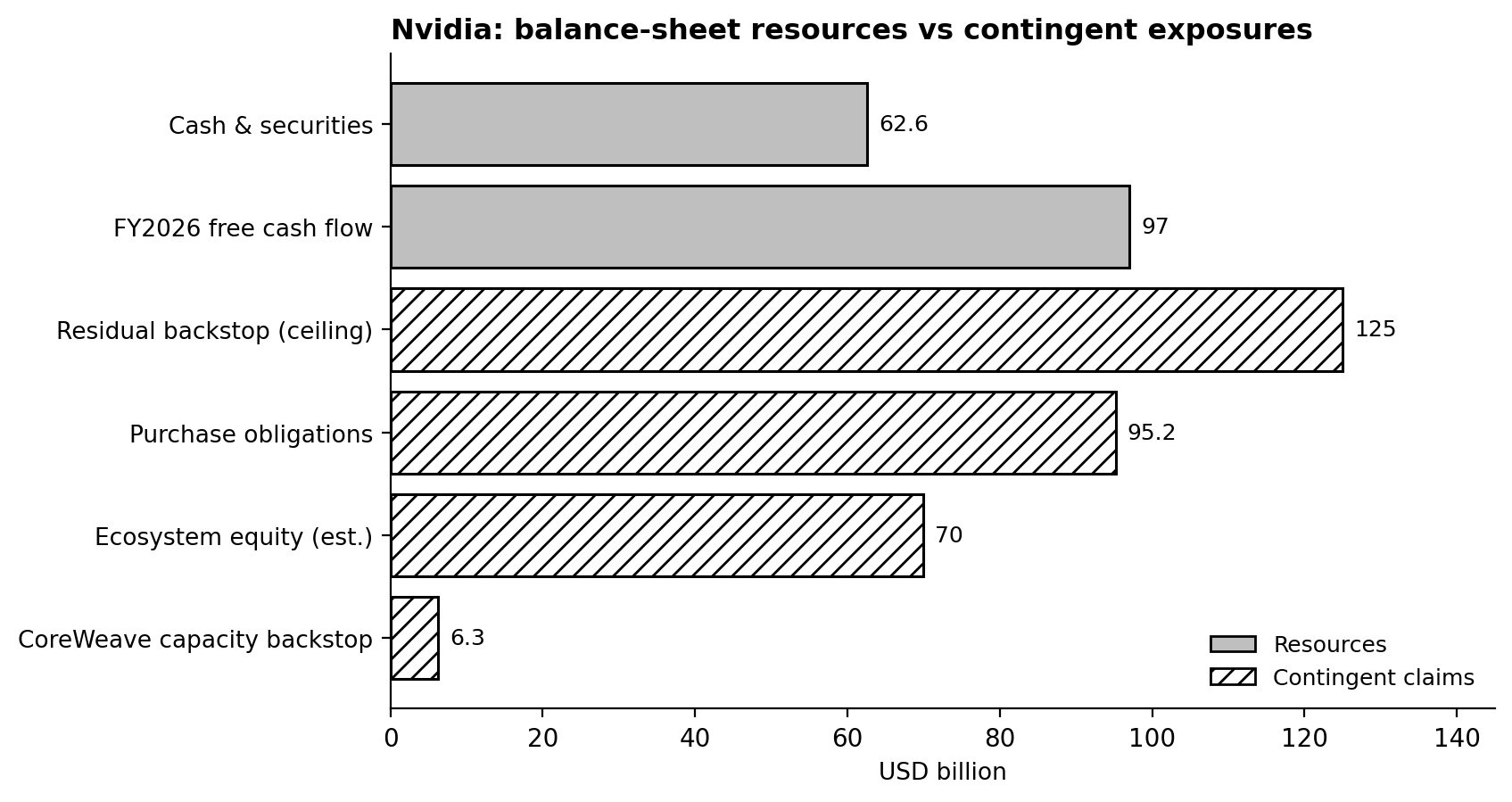
Figure 3. Nvidia balance sheet resources versus contingent exposures including the $125bn residual backstop
The European dimension
Europe enters this market as an investor. The continent hosts roughly 5% of global AI compute against about 75% for the US. Euro-area insurers hold about €211 billion of private credit, some 2.3% of assets, concentrated in Germany, France and the Netherlands and in a small number of large institutions. From January 2027, the revised Solvency II framework cuts the spread-risk capital charge on securitizations sharply, illustratively from about 46% to 22% for a three-year non-STS position. European insurance demand for precisely this paper will rise just as US regulators tighten the treatment of rated-note structures through which much of it is distributed. Supervisory reporting, meanwhile, cannot yet distinguish investment-grade asset-based finance from sub-investment-grade direct lending, so a growing exposure to GPU-backed structures will appear in the data as generic high-grade fixed income. Closing that measurement gap before the exposure grows, rather than after, is the practical lesson of this announcement for European supervisors.
Summary
The $500 billion platform converts short-lived hardware into long-dated investment-grade paper by borrowing the credit of the offtaker. Where the offtaker is a hyperscaler on a firm take-or-pay contract and the loan amortizes within the contract, the conversion is legitimate and the paper will very likely perform. Where the payer is a lab still raising the money it has already committed, or where loan tenor extends past contract tenor, the rating describes something the collateral cannot support. The risk has not been eliminated by the move to third-party capital; it has been re-domiciled, from a chipmaker's balance sheet to the general accounts of insurers, and the price charged for it, on the BIS's evidence, is roughly zero.
Sources
- Nvidia, press release, "NVIDIA Partners With Apollo, BlackRock, Blackstone, Brookfield, Goldman Sachs and KKR to Establish AI Compute Infrastructure Financing Platforms to Mobilize Over $500 Billion of Third-Party Capital," August 10, 2026 (structure, MOU status, partner list, borrower universe).
- Reuters, reporting Jensen Huang's statement on X, August 2026 ($125 billion / 25% backstop ceiling).
- Nvidia Form 10-K, fiscal year 2026, and Form 10-Q filings (cash and securities of $62.6bn; total debt; free cash flow; purchase obligations of $95.2bn vs $16.1bn prior year; CoreWeave $6.3bn capacity backstop; customer concentration).
- Moody's Investors Service (Nvidia Aa1, positive; CoreWeave DDTL 4.0 A3; commentary on hyperscaler lease disclosures and off-balance-sheet commitments); S&P Global Ratings (Nvidia AA; Meta Hyperion A+; Oracle downgrade to BBB-, July 9, 2026); Fitch Ratings (exposure draft on data-center securitization criteria, July 2025; A-sf on the CoreWeave facility); DBRS Morningstar (A(low)).
- CoreWeave, press release and Form 8-K on the $8.5bn delayed-draw term loan, March 31, 2026 (size, pricing, structure, anchor investor); CoreWeave quarterly filings (revenue, net losses, debt).
- Morgan Stanley / Meta announcements and contemporaneous reporting by Bloomberg and the Financial Times on the Hyperion financing (size, rating, yield, maturity, Blue Owl JV split, PIMCO and BlackRock allocations; allocations reported, not filed).
- Bank for International Settlements, Aldasoro, Doerr and Rees, BIS Bulletin No. 120, January 7, 2026 (AI-related private credit growth; spread comparison of 6.2 vs 6.1 percentage points; debt share of AI financing).
- Oracle Form 8-K and fiscal 2026 results (remaining performance obligations of $638bn; free cash flow of -$23.7bn); S&P Global Ratings downgrade rationale (OpenAI share of backlog).
- Sacra research and contemporaneous reporting (OpenAI annual recurring revenue of $25bn; projected 2026 cash burn of ~$27bn; itemized cloud commitments of $588bn across Microsoft, Oracle and AWS; estimates).
- Michael Burry, public posts, November 2025 – February 2026 (depreciation understatement estimate of $176bn, 2026–2028).
- Silicon Data, Mercatus and Hashrate Index (GPU residual value ranges).
- ECB Financial Stability Review, special feature, May 2026 (euro-area insurer private credit holdings of €211bn, 2.3% of assets; concentration by country and institution).
- Commission Delegated Regulation (EU) 2026/2692 and KKR analysis (Solvency II securitization spread-risk recalibration, illustrative reduction from 46% to 22%; application from January 30, 2027).
- Industry estimates of hyperscaler debt funding shares and 2025 data-center debt issuance of $182bn (Morgan Stanley and contemporaneous FT/Bloomberg reporting).
- IEA and contemporaneous reporting (European vs US shares of AI compute capacity).
Double-click to edit...
Double-click to edit...